Stuffed animals for awake play
A soft toy can belong in playtime without belonging in a baby's bed. Start with the setting, then check the age label.
U.S. guidance · Reviewed October 28, 2026
Keep plush out of infant sleep areas
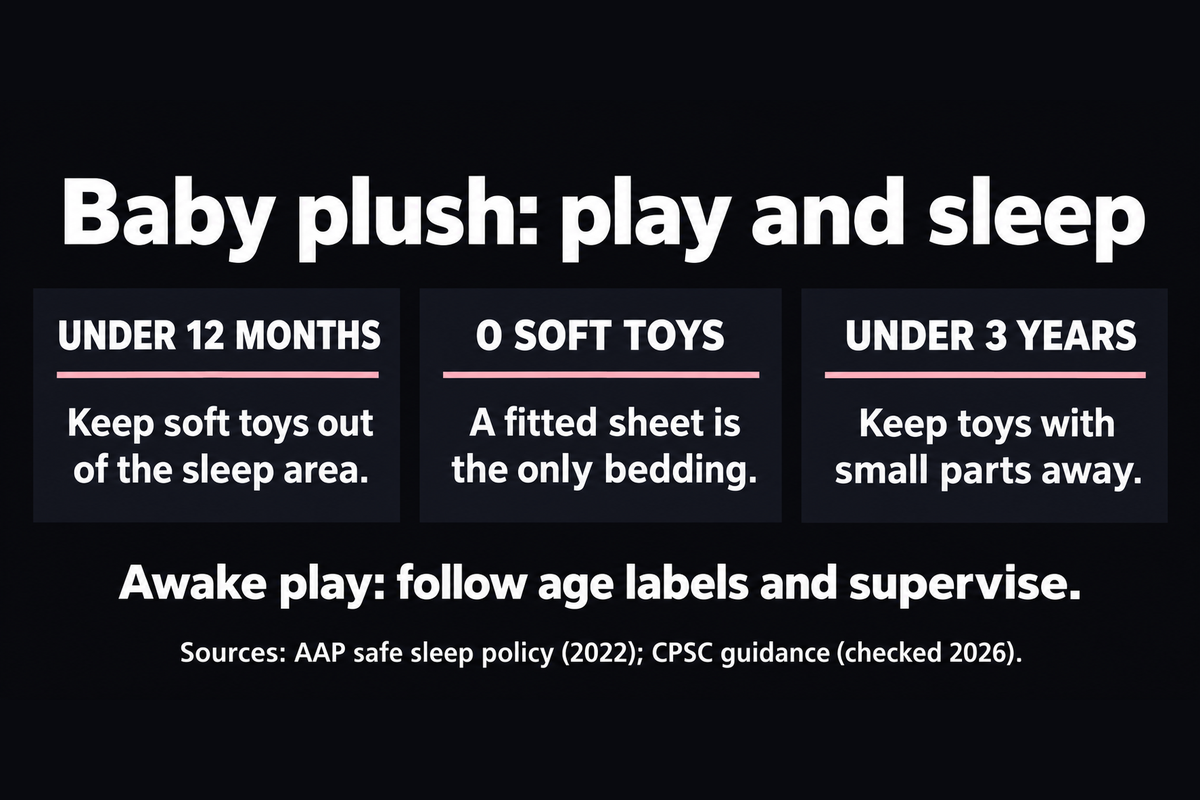
The American Academy of Pediatrics (AAP) recommends keeping soft objects and loose bedding away from an infant's sleep area. Its 2022 policy applies to the first year after birth, unless a recommendation states otherwise. For babies under 12 months, this includes stuffed animals and blanket-style comfort toys.
Place your baby on their back for each sleep. Use a firm, flat mattress in a crib, bassinet, or play yard that meets federal requirements. Use only a fitted sheet. The Consumer Product Safety Commission (CPSC) gives this advice in its Safe Sleep guidance, checked in 2026.
Rolling does not make a stuffed animal suitable for the crib. A toy can cover the nose or mouth. Keep the sleep space clear for naps as well as overnight sleep.
Sources: AAP safe sleep policy (2022); AAP parent guide (2026); CPSC Safe Sleep (checked 2026).
Baby plush readiness guide
Enter completed months and choose a setting. The result matches published guidance to your choices. It cannot check a toy, your child's development, or a medical condition.
Guide range: birth to 36 months.
Under 12 months: no plush in the sleep area
Keep soft toys and loose bedding out of the sleep area. Use a firm, flat sleep surface with a fitted sheet.
Sources: AAP safe sleep policy (2022); CPSC Safe Sleep (checked 2026).
Method: age selects the under-12-month sleep guidance and the under-3 toy precautions. Setting selects sleep, play, or travel advice. No age gives automatic approval. Educational tool, not medical advice.
Choose a toy for supervised play
CPSC's Toys guidance, checked in 2026, says to follow age labels and choose toys that match the child's abilities. A label for older children does not become suitable because an adult watches. Keep toys with small parts away from children under 3 years.
CPSC explains that 16 CFR part 1501 bans covered products for children under 3 that present small-part choking, aspiration, or ingestion hazards. Small parts include pieces that break off during use-and-abuse testing. This is a product safety rule, not a home inspection certificate.
- Check that eyes, noses, and other parts remain firmly attached.
- Check seams and edges for damage before play.
- Remove loose ribbons and strings.
- Choose a washable toy and follow its cleaning instructions.
- Put the toy away before sleep.
These checks follow the AAP's How to Buy Safe Toys guidance, checked in 2026. They help you inspect a toy; they do not replace required testing. CPSC's Toy Safety Business Guidance explains the mandatory ASTM F963 requirements and seam testing for stuffed toys.
For awake play, stay with your baby and keep the toy away from their face. Stop using a damaged toy. Check CPSC recalls before using a secondhand toy.
Sources: CPSC Toys, Small Parts Ban, and Toy Safety Business Guidance (checked 2026); AAP toy guidance (checked 2026).
Car seats and strollers need separate checks
The AAP's 2022 policy does not recommend sitting devices for routine infant sleep. If your infant falls asleep in a car seat or stroller, move them to an appropriate flat sleep surface when safe and practical. Keep the child correctly restrained during travel.
Do not place a plush toy behind the child's head or under a car-seat harness. AAP car-seat guidance says extra products must come with the seat or have the manufacturer's specific approval. Follow the seat instructions.
For stroller play, follow the stroller and toy instructions. Keep supervision active. A plush toy does not make a stroller suitable for routine infant sleep.
Sources: AAP safe sleep policy (2022); AAP Car Seats: Information for Families (checked 2026); AAP stroller guidance (2022); CPSC Toy Safety Business Guidance (checked 2026).
What the Safe Sleep for Babies Act covers
The Safe Sleep for Babies Act of 2021 became law on May 16, 2022. Its ban took effect on November 12, 2022. CPSC explains that the law bans crib bumpers and inclined sleepers for infants, as the Act defines them.
The law prohibits their sale, manufacture for sale, distribution in commerce, and import into the United States. It does not certify stuffed animals for sleep. Toy safety requirements and infant sleep recommendations address different risks.
Source: CPSC Safe Sleep for Babies Act Business Guidance (2022 law; checked 2026).
What changes after the first birthday?
The infant guidance does not establish a universal safe age for every toy. Michigan's health department says research does not establish a completely safe point for soft objects in a crib. Discuss your child's sleep environment with their pediatrician. Continue to follow toy age labels.
Source: Michigan Department of Health and Human Services, safe-sleep FAQ (checked 2026).
Source notes
The source names beside each section identify the guidance used here. Years show publication dates where stated; “checked 2026” identifies our review year. This guide covers U.S. recommendations. It does not provide product endorsements or individual medical advice.